 +91 954 002 5025 (24/7)


To Book an Appointment
Call Us+91 954 002 5025To Book an Appointment
Call Us+91 954 002 5025The Best Diet For Your Speed Recovery After Heart Bypass Surgery
By Dr. Ramji Mehrotra in Heart & Vascular Institute
Aug 09 , 2022 | 7 min read
17

What is Heart Bypass Surgery?
Heart bypass surgery is done to repair the damaged arteries of the heart. However, it’s time for a change towards a healthy diet and a better lifestyle to prevent further heart ailments in the future.
Best Diet Plan After Heart Bypass Surgery
Following a good diet plan will help in weight control, which is important in maintaining healthy cardiovascular health. A professional dietician can help one choose a proper diet plan that is good for recovery and health. Notably, heart bypass surgery is effective and proportional to a healthy lifestyle.
There are many healthy diet after heart bypass surgery which include:
- Meat
- Whole grains
- Fish
- Dairy
- Healthy Fats
- Water
Food to Eat After Heart Bypass Surgery
A healthy balanced diet will provide various healthy nutrients that will aid in recovery. After coronary heart bypass surgery avoids low saturated fats but has high fibre and rich omega-3 foods.
Here are some foods which you eat after heart bypass surgery:
Meat
Eat only lean meat (trim the fat off the meat), and consume it moderately.
Whole grains
Grains including brown rice, wholemeal pasta, oats, barley, rye, quinoa and wholewheat bread should be consumed for a healthy heart.
Fish
Eating fish once a week will ensure that omega-3 fatty acids are included in the diet, which is good for the heart.
Dairy
Low fat is preferred to keep the blood vessels clear after heart bypass surgery. Consuming skimmed milk, yoghurt and fat-free cream cheese is advised.
Healthy Fats
Use unsaturated oils, low-fat mayo and spreads that are low in trans fatty acids. Use unsaturated fat options like avocados, pumpkin seeds, peanuts, olive oil and canola oil.
Water
Replace sugar-filled drinks with homemade fresh fruit juices, or simply drink a lot of normal water.
Explore the expert guide - Home Remedies For Acidity (Acid Reflux or Heartburn) Relief and How a Dietitian Chart Can Help You Manage Your Diet and Achieve Your Health Goals.
Foods to Avoid After Heart Bypass Surgery
After Heart Bypass Surgery avoids saturated fat and cholesterol. Avoid unhealthy foods to recover the body tissues.
Here are the foods you avoid after Heart Bypass Surgery:
- Hydrogenated and trans-fat products
- Avoid sugary foods
- High sodium intake
- Refined grains
- Alcohol
Hydrogenated and trans-fat products
Limit the consumption of saturated fat and avoid trans-fat products. Saturated fat should not be taken more than 6% of the total daily calories if the cholesterol level is high.
Avoid sugary foods
Say no to sugary foods or drinks, they have high calories. Avoid drinks that have high sugar or corn syrup. Sugary foods increase body weight, which is not good for the heart.
High sodium intake
Low sodium intake in diet will help prevent fluid retention and also reduce blood pressure.
Refined grains
They are rich in sugar and have less fibre, so it’s better to avoid them.
Alcohol
Avoid the excessive consumption of alcohol. Alcohol has high calories, but it does not provide any nutrition. Ensure to take it in moderation.
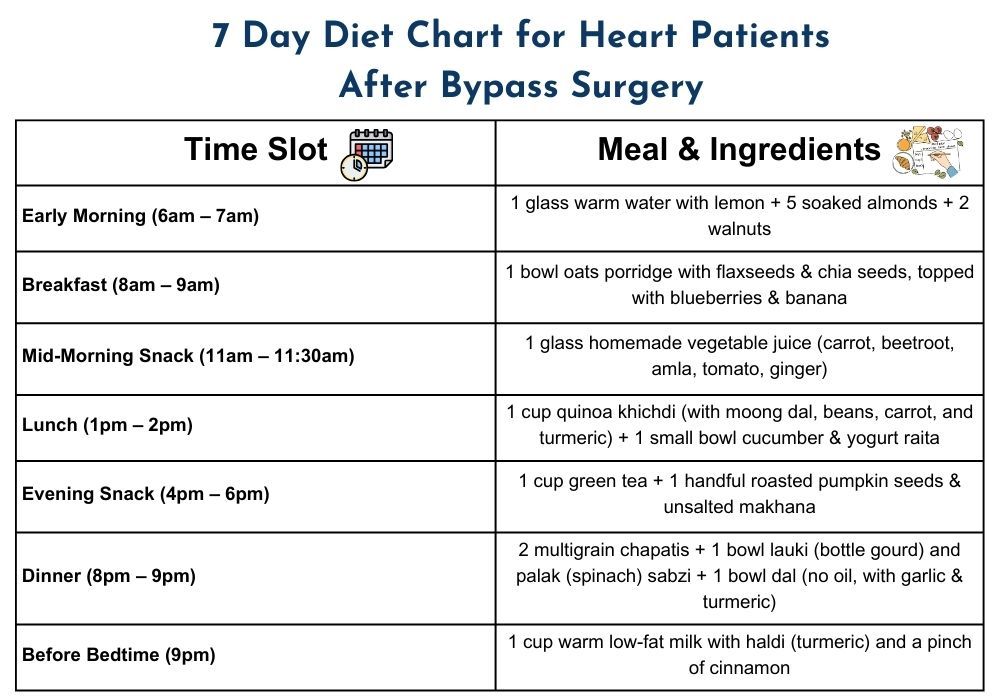
7 Days Indian Diet Chart for Heart Patients After Bypass Surgery
| Days | Early Morning (6am – 7am) |
Breakfast (8am – 9am) |
Mid Morning Snack (11am – 11:30am) |
Lunch (1pm – 2pm) |
Evening Snack (4pm – 6pm) |
Dinner (8pm – 9pm) |
Before Bedtime |
| Sunday | 1 pomegranate, 1 glass coconut water | Thalipeeth/ veg paratha with curd | 1 glass of buttermilk, ½ cup sundal | Veg pulao, paneer masala | 1 cup sprout salad | 2 millet chapati, 1 bowl dal with methi, ¼ cup tomato raita | 1 cup low-fat milk with infuse ginger/haldi |
| Monday | 1 cup tea, Salad (fruits, sprouts), coconut water | 1 cup mixed veg poha with sprouts, 1 cup tea, 1 Apple | Buttermilk, Wheat biscuits | 1 cup brown rice with dal, carrots and beans, raita | Unsalted makhana, 1 cup green tea | 2 multi-grain chapati, cauliflower / cabbage curry | 1 cup low-fat milk with infuse ginger/haldi |
| Tuesday | 1 cup tea, 1 small cup of oats, 1 banana, coconut water | 2 multi-grain bread veg sandwich, paneer veg toast, 1 cucumber | Buttermilk with Trail mix (nuts, dry fruits and seeds) | 2 multi-grain chapati, palak paneer, onion tomato salad, raita | 1 cup curd with black salt, Roasted chana and peanuts | 1 cup brown rice with rajma sabzi | 1 cup low-fat milk with infuse ginger/haldi |
| Wednesday | 1 cup tea, 1 cup vegetable soup, 1 multi-grain bread slice toasted | Oatmeal or oats appam, 1 apple, 1 pomegranate | Buttermilk and roasted/boiled chana | 1 cup brown rice, dal with spinach, beans & carrot poriyal | 1 cucumber with salt and pepper, 2 multi-grain crackers | Baked vegetable platter (beans, carrot, broccoli, baby corn, mushroom) | 1 cup low-fat milk with infuse ginger/haldi |
| Thursday | 1 cup tea, 1 glass green smoothie (spinach, kale with fruits like apple, banana, mango) | 2 dosas with sambar and peanut chutney | Buttermilk with baked wheat-based samosa/kachori | 2 multi-grain chapati, bhindi masala gravy, 1 small cup curd | 1 glass buttermilk, 2 methi khakhras | 1 cup rice, tomato rasam, spinach roast, roasted papad | 1 cup low-fat milk with infuse ginger/haldi |
| Friday | 1 cup tea, 1 bowl of berries (raspberries, strawberries, blueberries), and nuts (walnuts, almonds, macadamia nuts) | 1 serving Pongal with coconut chutney, rava upma | Buttermilk with roasted masala papad topped with tomato and cucumber | 2 methi multi-grain parathas, mixed veg gravy | 1 glass fruit juice, 2 multi-grain crackers | 1 cup rice, curd, beetroot poriyal, stir fried bhindi | 1 cup low-fat milk with infuse ginger/haldi |
| Saturday | 1 cup tea, 1/2 cup sundal (boiled chickpeas) | 3 idlis with drumstick and vegetable sambar | 1 cup buttermilk, 1 roasted masala papad topped with tomato and cucumber | 3 chapati, dal tadka, onion tomato raita | Tea/coffee, bhel without sev and puri | Jeera rice + dal, gobi sabzi | 1 cup low-fat milk with infuse ginger/haldi |
Medications After Heart Bypass Surgery
The Heart bypass surgery doctor will prescribe medicine to keep heart disease under control. It is important to take all the medicines as prescribed for better results.
The doctor may prescribe the following medications after bypass surgery:
- Antiplatelet Will help in reducing the risk of heart attack and in preventing blood clots.
- Beta-blockers help lower blood pressure. Decrease the workload of the heart.
- ACE inhibitors help in lowering blood pressure and reducing the pressure from the heart.
- Lipid-lowering medicines decrease the amount of LDL cholesterol in the blood.
Other Medicines
Depending on other risk factors, medicines can be prescribed for the following conditions: Insulin or drugs will be given to people with diabetes to keep blood sugar within control. This medication decreases the risk of heart disease and diabetes-related complications.
How to Get Back to Regular Activities After Heart Bypass Surgery?
The breastbone takes a minimum of two months to heal after a coronary heart bypass surgery. Resuming activities after a heart bypass surgery is a gradual process.
Start with some light activities like small household chores, and then gradually, one can resume heavy activities like
- Driving
- Sex
- Office work
- Gardening
- House work
Driving
Avoid driving for several weeks, as it is an activity that requires concentration and reflex time. It is better to avoid driving any vehicle for a few weeks to aid recovery.
Sex
Sexual activity requires physical straining, and it may cause pain in the breastbone if the recovery is not complete. So it is better to avoid it for 3 months.
Office work
Office work can be resumed after 6 weeks.Work-life can be reinstated once confidence is back and the body has recovered completely.
Gardening
It can be strenuous, but light activities like weeding and pruning can be started by the third week. After two months, completely resume the gardening activities.
House work
Start with small activities such as light cooking. Avoid doing heavier tasks as it may interfere with recovery.
Which Exercises are the Best to Start After Heart Bypass Surgery?
The following exercises are good to start after surgery:
- Bowls
- Tennis
Bowls
People can start practising after 6 weeks.
Tennis
One can start with gentle serving after 6 weeks.
Learn more about - Ways To Strengthen Your Immune System and Dash Diet Chart Plan.
Side Effects After Heart Bypass Surgery
After the bypass surgery, people may experience some side effects as a result of the operation. These can include
- Nausea
- Constipation
- Loss of appetite
Nausea
It is a common side effect when a patient has anaesthesia for surgery. The exact physiology of nausea after heart bypass surgery is not clearly understood. Nausea is often triggered due to various factors, such as anaesthesia, illness, anxiety, perioperative stimuli and drug interactions.
Constipation
It happens due to a lack of physical activity, insufficient fibre intake due to post-operative dietary changes, pain medications and insufficient intake of water.
Loss of appetite
People may observe they have lost their appetite and may not find the food delectable. The taste bud has changed. This is caused because of the medication post-surgery. It will take 3 months to get back to their normal appetite. It’s perfectly normal to experience a bit of low owing to the surgery. There would be moments when we would experience highs and lows. It usually takes weeks (almost 4-6) to recover.
Read more about - 7 Myths About Hypertension and Facts
Conclusion
Blood flow increases to the heart after bypass surgery. Good outcomes are observed in people who make healthy lifestyle habits. Talk to the doctor about healthier options so that it continues on overall well-being towards a better life.
BLK-Max Hospital is the leading heart hospital in Delhi. Possible changes can be made by choosing a healthier diet, reducing alcohol intake, avoiding smoking and exercising regularly. All of the above along with the prescribed drugs will ensure a healthier and happier heart with smiles all over.
Explore our expert-backed guide on Diet Chart for Weight Loss
Frequently Asked Questions
1. What is heart bypass surgery?
Heart bypass surgery is a procedure to repair blocked or damaged heart arteries, improving blood flow to the heart.
2. What diet should be followed after heart bypass surgery?
A heart-healthy diet includes lean meats, whole grains, fish, low-fat dairy, healthy fats, and plenty of water.
3. Which foods should be avoided after heart bypass surgery?
Avoid trans fats, sugary foods, high sodium intake, refined grains, and excessive alcohol consumption.
4. How long does recovery take after heart bypass surgery?
Recovery varies, but the breastbone takes around two months to heal, and full recovery may take several months.
5. When can I drive after heart bypass surgery?
Driving should be avoided for several weeks until your doctor confirms it is safe.

Written and Verified by:

Related Blogs


Medical Expert Team
Feb 26 , 2019 | 3 min read

Blogs by Doctor

7 Key Facts to Understand About Cardiac Stress Test
Dr. Ramji Mehrotra In Heart & Vascular Institute
Apr 20 , 2023 | 6 min read

Understanding Gym Heart Attack: A Hidden Risk in Fitness Enthusiasts
Dr. Ramji Mehrotra In Heart & Vascular Institute
Mar 05 , 2023 | 4 min read

Surgical Options for Heart Failure: When Is It Necessary?
Dr. Ramji Mehrotra In Heart & Vascular Institute
Jun 26 , 2023 | 4 min read
Most read Blogs


Related Blogs
Medical Expert Team
Feb 26 , 2019 | 3 min read
Blogs by Doctor
7 Key Facts to Understand About Cardiac Stress Test
Dr. Ramji Mehrotra In Heart & Vascular Institute
Apr 20 , 2023 | 6 min read
Understanding Gym Heart Attack: A Hidden Risk in Fitness Enthusiasts
Dr. Ramji Mehrotra In Heart & Vascular Institute
Mar 05 , 2023 | 4 min read
Surgical Options for Heart Failure: When Is It Necessary?
Dr. Ramji Mehrotra In Heart & Vascular Institute
Jun 26 , 2023 | 4 min read
Most read Blogs
