 +91 954 002 5025 (24/7)


To Book an Appointment
Call Us+91 954 002 5025To Book an Appointment
Call Us+91 954 002 5025Dermatologists vs Skin Specialists: Navigating Skin Care Professionals
By Dr. Hemant Sharma in Dermatology , Paediatric Dermatology
Nov 25 , 2024 | 8 min read

Your skin is a protective barrier and a reflection of your overall health. Whether you are dealing with persistent acne, curious about anti‑ageing options, or concerned about a new or changing mole, choosing the right professional for your concern is crucial. Many people are unsure whether to book an appointment with a dermatologist or another type of skin specialist such as an esthetician or cosmetic therapist. While all of these experts focus on improving the skin, their qualifications, scope of practice, and the types of problems they are trained to manage are very different.
This guide explains the differences between dermatologists and non‑medical skin specialists, including their training, roles, and the situations where each is appropriate. Understanding these differences can help you make informed, safe decisions about your skin health and cosmetic goals.
What is a skin specialist?
Definition and role
“Skin specialist” is a broad, non‑technical term that may refer to different professionals working in skincare, many of whom are not medical doctors. This can include:
- Estheticians or cosmetologists: Trained to provide cosmetic, non‑medical treatments such as facials, superficial chemical peels, and basic skin care services.
- Cosmetic skin therapists: Professionals who may offer advanced but still non‑medical, minimally invasive cosmetic procedures depending on local regulations.
- Cosmetic dermatologists: Fully qualified dermatologists (medical doctors) who have additional expertise and a practice focus in aesthetic procedures such as lasers, injectables, and scar treatments.
These practitioners primarily focus on improving the appearance and comfort of the skin rather than diagnosing or treating underlying medical diseases.
Read more about - Scars: Types, Causes, and Treatment Options.
Education and training
Training for non‑medical skin specialists varies widely and is generally much shorter than medical training.
- Estheticians usually complete a structured course through an accredited beauty or cosmetology school and then pass a licensing or certification exam, depending on local requirements.
- Cosmetic skin therapists may complete additional certification programmes focused on specific devices or procedures, but they are typically not trained to diagnose or manage medical skin diseases.
- Cosmetic dermatologists, in contrast, first complete full dermatology training as doctors and then focus on aesthetic treatments as a subspecialty.
Importantly, non‑doctor skin specialists should not diagnose serious skin diseases, prescribe medicines, or perform medical or surgical procedures that are restricted to licensed physicians.
Know more about - Types of Skin Infections.
What is a dermatologist?
Definition and role
A dermatologist, commonly known as a skin doctor, is a medical specialist who diagnoses and treats conditions affecting the skin, hair, nails, and some mucous membranes. Dermatologists are trained to manage both medical and cosmetic concerns and can perform procedures ranging from minor surgeries to advanced laser treatments.
They commonly treat:
- Acne, eczema, psoriasis, and other inflammatory skin diseases
- Skin cancers and precancerous lesions
- Hair loss (alopecia) and nail disorders
- Cosmetic concerns such as scars, wrinkles, and pigmentation problems, using medical‑grade procedures and prescription treatments when appropriate
Dermatologists also perform procedures such as biopsies, excisions, Mohs surgery for selected skin cancers, chemical peels, injectables, and various laser therapy treatments.
Read more about - Skin Cancer Surgery & Its Side Effects.
Education and training
To become a dermatologist in India, doctors must complete a long and structured training pathway.
- 5.5 years of MBBS, including a compulsory rotating internship
- 3 years of MD or DNB in Dermatology, Venereology, and Leprosy (or an equivalent postgraduate programme)
- Optional fellowship or subspecialty training (for example, paediatric dermatology or Mohs micrographic surgery) for additional expertise
After this training, dermatologists are licensed to diagnose and treat skin diseases, prescribe medications, and perform both surgical and cosmetic procedures within their scope.
Dermatologist vs skin specialist: key differences at a glance
While both dermatologists and non‑medical skin specialists contribute to skin care, they differ greatly in training, legal responsibilities, and the types of conditions they can safely manage.
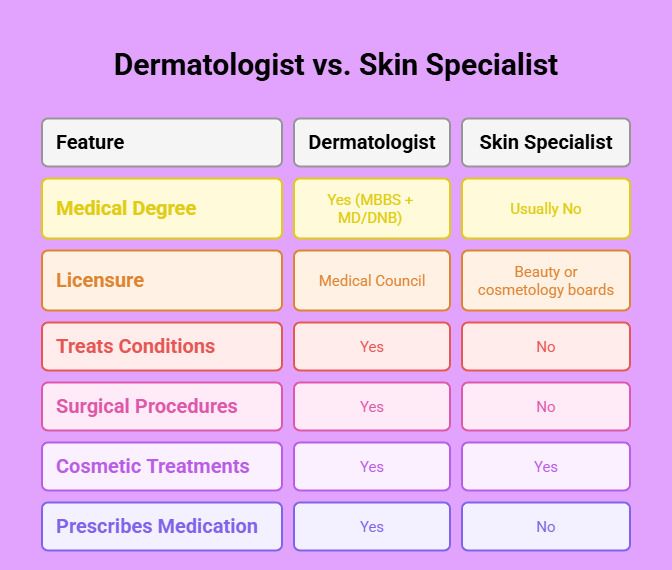
Summary table
| Feature | Dermatologist (medical doctor) | Skin specialist (non‑medical, except cosmetic dermatologists) |
| Medical Degree | Yes (MBBS + MD/DNB or equivalent) | Usually no (except cosmetic dermatologists who are fully trained doctors) |
| Licensure | Medical council registration | Beauty/cosmetology boards or local licensing bodies |
| Treats Medical Conditions | Yes, including serious and chronic skin diseases | No, should not diagnose or treat medical skin diseases |
| Performs Surgical Procedures | Yes (biopsies, excisions, some reconstructive surgery) | Generally no surgical procedures; focus on non‑invasive cosmetic care |
| Cosmetic Treatments | Yes (lasers, medical peels, injectables, scar treatments) | Yes (facials, superficial peels, microdermabrasion, basic device‑based treatments depending on regulation) |
| Prescribes Medication |
Yes, including topical and systemic medicines | No prescribing rights in most cases |
Scope of practice
Dermatologists are trained to treat complex skin, hair, and nail conditions, such as psoriasis, severe acne, autoimmune diseases, and skin cancers, and can perform appropriate medical and surgical interventions. Non‑medical skin specialists usually focus on maintaining or enhancing the skin’s appearance and comfort using non‑invasive methods.
Qualifications and training
Dermatologists complete a full medical degree followed by specialist training in dermatology, often with board or equivalent certification that reflects advanced expertise. In contrast, the training of non‑doctor skin specialists is shorter, with coursework focused on cosmetic techniques rather than disease diagnosis or systemic treatment.
Types of treatments offered
- Dermatologists: Medical treatments for skin diseases, minor surgeries (e.g., mole removal, biopsies), skin cancer care, and advanced cosmetic procedures such as lasers, fillers, and medical‑grade peels.
- Skin specialists (non‑medical): Cosmetic and maintenance‑focused services like facials, superficial peels, microdermabrasion, and basic device‑based treatments for texture and tone improvement, within the scope allowed by local regulations.
You can explore our dermatology services for skin health to learn about advanced treatments and personalised care options.
Similarities between dermatologists and skin specialists
Despite clear differences in training and legal responsibilities, dermatologists and non‑medical skin specialists share a common goal of helping people feel more confident in their skin.
Focus on skin health and appearance
Both groups aim to improve the look and comfort of the skin, but dermatologists prioritise diagnosing and treating diseases and risk factors, while non‑medical specialists focus on cosmetic maintenance and enhancement.
Overlapping treatments
There is some overlap in the types of cosmetic procedures offered, such as superficial peels or certain types of laser or light‑based treatments. However, medical‑grade or deeper procedures, and any treatment that carries a higher risk of complications, are best performed under the supervision of a dermatologist or qualified medical team.
When to choose a dermatologist or a skin specialist
See a dermatologist if you have:
- Persistent or severe acne, rashes, or itching that does not settle with basic skincare
- A new, changing, or non‑healing mole, patch, or growth that could be suspicious for skin cancer
- Chronic conditions such as eczema, psoriasis, vitiligo, or autoimmune rashes
- Hair or nail disorders such as sudden hair loss, nail deformities, or painful nail infections
- A need for biopsies, mole removal, or other minor skin surgeries
See a non‑medical skin specialist mainly for:
- Routine facials, basic peels, and general skincare maintenance
- Mild cosmetic concerns such as dullness or very early signs of ageing, when there is no underlying disease suspected
- Short‑term aesthetic enhancements and product‑related guidance, ideally coordinated with your dermatologist if you have medical skin conditions
If you are uncertain whether your concern is purely cosmetic or medical, it is safer to start with a dermatologist, who can then work together with an esthetician or therapist if needed.
How to choose the right skin professional
Choosing between a dermatologist and a skin specialist depends largely on whether your concern is medical, cosmetic, or both. Medical or persistent problems are best assessed by a dermatologist, whereas routine cosmetic maintenance may be handled by trained non‑medical specialists.
Consultation checklist
During your first consultation, consider the following points:
- Check qualifications: Verify the practitioner’s credentials, including medical degree, dermatology training, and registration with the appropriate medical council for doctors, or recognised cosmetology/esthetician licensing for non‑medical providers.
- Assess experience: Ask about experience with your specific condition or procedure, including how often they perform it and typical outcomes.
- Understand treatment options: Discuss available options, including medical and non‑medical approaches, expected benefits, alternatives, and the level of evidence supporting each choice.
- Discuss potential risks and side effects: Review common and serious side effects, how they will be monitored, and what to do if problems arise.
- Set realistic expectations: Clarify what results are realistic, how many sessions may be required, and how long results are likely to last.
Care at BLK‑Max Super Speciality Hospital
At BLK‑Max Super Speciality Hospital, dermatology services are led by qualified specialists who manage both medical and cosmetic skin concerns using evidence‑based protocols. Our team focuses on accurate diagnosis, personalised treatment plans, and close follow‑up to help you achieve healthier skin safely.
If you are unsure which type of expert is right for you, you can book an appointment to discuss your concerns and be guided to the most appropriate specialist for your needs.
Frequently asked questions
1. What is the main difference between a dermatologist and a skin specialist?
The main difference is in training and scope of practice: dermatologists are medical doctors who diagnose and treat skin diseases, while non‑medical skin specialists focus on cosmetic skincare services and cannot usually diagnose or manage medical conditions.
2. Can a non‑medical skin specialist treat severe skin conditions?
No. Severe, persistent, or complex skin problems should be evaluated and treated by a dermatologist or other qualified doctor, as delayed or inappropriate treatment can worsen outcomes.
3. What qualifications should I look for in a dermatologist?
Look for an MBBS degree, a postgraduate qualification such as MD or DNB in Dermatology, Venereology, and Leprosy, recognised medical council registration, and preferably board or equivalent certification.
4. Are skin specialists qualified to perform cosmetic procedures?
Many estheticians and cosmetic skin therapists are trained and licensed to perform specific non‑invasive cosmetic procedures, but they are not trained to diagnose medical diseases or manage high‑risk treatments that require a doctor’s supervision.
5. When should I see a dermatologist instead of a skin specialist?
You should see a dermatologist whenever you have a suspected medical skin disease, severe or long‑lasting symptoms, suspicious moles or growths, or when prescription medicines, injections, or surgical procedures may be needed. For routine cosmetic care and basic maintenance, a trained non‑medical skin specialist may be sufficient, ideally with your dermatologist informed if you have underlying conditions.
Disclaimer: The information in this article is for general educational purposes only and is not a substitute for professional medical advice, diagnosis, or treatment. Always consult a qualified healthcare provider for personalised advice about your skin, hair, or nail concerns. In case of a medical emergency or rapidly worsening symptoms, seek in‑person care immediately.
References
1. AUAMED. (2024, November 17). Esthetician vs. dermatologist – Key roles and differences. Retrieved from https://www.auamed.org/blog/esthetician-vs-dermatologist/
2. Spectrum Laser Training. (2022, August 31). The differences between esthetician vs dermatologist. Retrieved from https://www.spectrumlasertraining.com/blog/dermatologist-vs-esthetician
3. Derm On Demand. (2025, October 24). Difference between a dermatologist and an esthetician – Guide. Retrieved from https://dermondemand.com/blog/difference-between-a-dermatologist-and-an-esthetician/
4. Authority Doctors. (2025, June 30). SEO for dermatologists: How to acquire more dermatology patients. Retrieved from https://authoritydoctors.net/medical-practice-search-engine-optimization-seo/seo-for-dermatologists/
5. DOT IT. (2025, July 3). SEO for healthcare businesses: Grow patient leads online. Retrieved from https://www.dotit.io/post/seo-for-healthcare-businesses

Written and Verified by:

Related Blogs

Medical Expert Team
Mar 20 , 2019 | 5 min read

Dr. Hemant Sharma In Dermatology , Paediatric Dermatology
Jun 23 , 2023 | 7 min read

Blogs by Doctor
Importance of Comprehensive Dermatology Services for Skin Health
Dr. Hemant Sharma In Dermatology , Paediatric Dermatology
Jun 23 , 2023 | 7 min read

Scars: Types, Causes, and Treatment Options
Dr. Hemant Sharma In Dermatology
Jan 23 , 2025 | 4 min read
Most read Blogs


Related Blogs
Medical Expert Team
Mar 20 , 2019 | 5 min read
Dr. Hemant Sharma In Dermatology , Paediatric Dermatology
Jun 23 , 2023 | 7 min read
Blogs by Doctor
Importance of Comprehensive Dermatology Services for Skin Health
Dr. Hemant Sharma In Dermatology , Paediatric Dermatology
Jun 23 , 2023 | 7 min read
Scars: Types, Causes, and Treatment Options
Dr. Hemant Sharma In Dermatology
Jan 23 , 2025 | 4 min read
Most read Blogs
